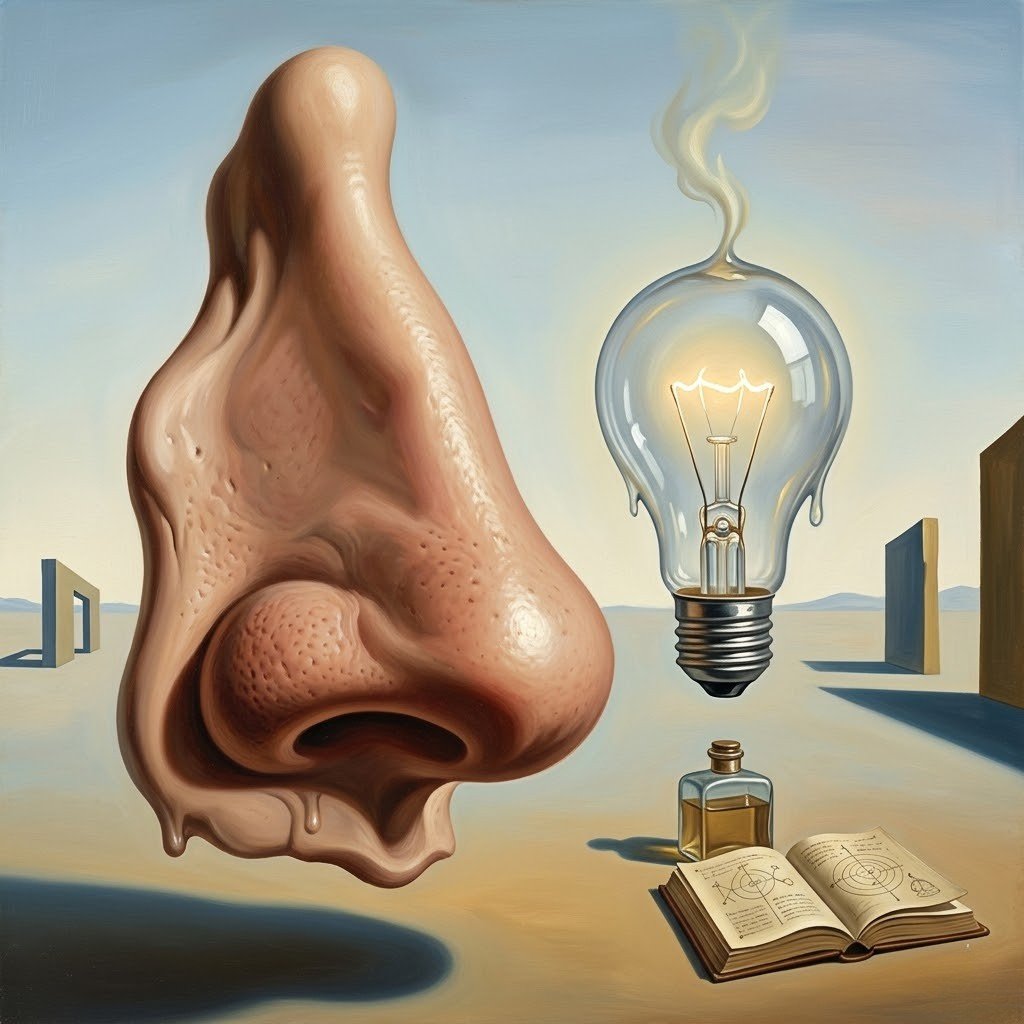
𝘈 𝘤𝘰𝘨𝘯𝘪𝘵𝘪𝘷𝘦 𝘯𝘦𝘶𝘳𝘰𝘴𝘤𝘪𝘦𝘯𝘵𝘪𝘴𝘵 𝘩𝘢𝘴 𝘪𝘥𝘦𝘯𝘵𝘪𝘧𝘪𝘦𝘥 𝘢 𝘤𝘰𝘮𝘱𝘭𝘦𝘵𝘦𝘭𝘺 𝘭𝘦𝘨𝘢𝘭 𝘵𝘦𝘤𝘩𝘯𝘪𝘲𝘶𝘦 𝘧𝘰𝘳 𝘪𝘮𝘱𝘳𝘰𝘷𝘪𝘯𝘨 𝘦𝘹𝘢𝘮 𝘱𝘦𝘳𝘧𝘰𝘳𝘮𝘢𝘯𝘤𝘦 𝘵𝘩𝘢𝘵 𝘢𝘭𝘮𝘰𝘴𝘵 𝘯𝘰𝘣𝘰𝘥𝘺 𝘪𝘴 𝘶𝘴𝘪𝘯𝘨 … 𝘺𝘰𝘶𝘳 𝘯𝘰𝘴𝘦.
You are sitting in an exam room. Did you study? Oh yes, you definitely studied. But the answers do not come.
You can almost see the page the information was on, your bright yellow highlighter colour, even the margin notes you made at 11 PM when the concept finally clicked. But try as you might the harder you reach for it the further it retreats.
Almost everyone has lived this moment. I am about to share a trick using fragrances few people know of to make sure it does not happen again. What follows is stranger than you expect and more scientifically grounded than you might imagine.
𝐂𝐡𝐞𝐚𝐭𝐢𝐧𝐠 𝐰𝐢𝐭𝐡𝐨𝐮𝐭 𝐜𝐡𝐞𝐚𝐭𝐢𝐧𝐠
A cognitive neuroscientist named Rachel Herz calls it cheating without cheating. It exploits a genuine neurological mechanism rather than introducing information that was not studied. You cannot smell your way to knowing something you never learned. But you might smell your way to remembering something you learned but cannot immediately access under pressure.
There are fragrances that immediately recall memories. Yves Saint Laurant Opium Pour Homme reminds me of watching the Chicago Bulls playing in the 90s, and Amouage Interlude Black Iris reminds of smelling fires burn while driving to my grandparents home in Pakistan. I’m sure you also have memories tied to certain scent profiles.
Here is the technique explained in three steps:
 Choose a fragrance that is genuinely unusual to your nose. Not something you wear regularly. Not something familiar from your past. Something strange and specific that your olfactory system has no existing associations with. This is the most critical requirement.
 Apply this fragrance during every serious study session for the material you need to retain. The smell becomes encoded in your brain as part of the study context. Your brain begins to associate the unusual scent with the specific information you are learning.
 Apply the same fragrance immediately before your exam or high stakes assessment. The sensory context of the study session is now partially reinstated and access to the encoded information is enhanced.
You are not going to get in trouble for using this technique. It enhances retrieval of material that was actually studied. It does not create knowledge and it does not replace preparation. Think of it as a retrieval aid not a miracle.
𝐖𝐡𝐚𝐭 𝐭𝐨 𝐚𝐜𝐭𝐮𝐚𝐥𝐥𝐲 𝐛𝐮𝐲 𝐚𝐧𝐝 𝐰𝐡𝐲 𝐭𝐡𝐞 𝐬𝐭𝐫𝐚𝐧𝐠𝐞𝐬𝐭 𝐨𝐩𝐭𝐢𝐨𝐧 𝐰𝐨𝐫𝐤𝐬 𝐛𝐞𝐬𝐭
This is where fragrance expertise adds something a neuroscientist cannot provide. The most effective memory anchor fragrances are almost certainly not the ones you would choose to wear for any other purpose. You do not want to use your favourite fragrance. You want to use the most unusual and strange fragrance you can find to make sure the memory of smelling it stands out in your mind.
As someone who owns and writes about serious fragrances professionally, I can tell you that the most memorable and unusual smells are rarely the most expensive ones. It can mean something challenging or even initially unpleasant rather than beautiful. Do not break the bank with some edgy niche scent. Instead, experiment with single-note fragrances that smell genuinely odd. Inexpensive aromatherapy blends used in no other context are perfect. Even something from a health food store that you would never otherwise reach for.
Spend 10-15 simoleons on something genuinely unusual that you would never otherwise wear. Use it only for studying. The stranger the better.
The counterintuitive truth is that the most effective memory anchor fragrance might be the least beautiful one you have ever smelled.
So why does it work? The answer takes us from a French novelist writing in the early twentieth century to a Canadian neuroscientist with an fMRI machine and three decades of published research. The connection between them is your nose.
𝐖𝐡𝐚𝐭 𝐏𝐫𝐨𝐮𝐬𝐭 𝐮𝐧𝐝𝐞𝐫𝐬𝐭𝐨𝐨𝐝 𝐛𝐞𝐟𝐨𝐫𝐞 𝐭𝐡𝐞 𝐬𝐜𝐢𝐞𝐧𝐜𝐞 𝐞𝐱𝐢𝐬𝐭𝐞𝐝
In the early pages of his monumental novel In Search of Lost Time, Marcel Proust described dipping a small madeleine cake into lime blossom tea and being suddenly and completely flooded with his childhood.
If you have ever watched Ratatouille you know exactly what I mean. Remember the scene in which the food critic Anton Ego was immediately transported back to his childhood when he tasted Remy’s dish? That is exactly what I am talking about.
These are not vague impressions. They are a full sensory restoration of an entire world you did not know you still remembered. Proust called it involuntary memory. He spent thousands of pages trying to understand why it arrived through taste and smell rather than through any deliberate act of recollection.
What Proust could not know was that he was describing a specific neurological mechanism that scientists would not fully map until a century later. He experienced it with extraordinary precision and literary genius.
I have never read Proust but now I might have to, thanks to Dr. Rachel Herz citing him in The Scent of Desire. Herz is a Canadian cognitive neuroscientist who completed her foundational training at Queen’s University and the University of Toronto before joining the faculty at Brown University where she now holds a position in the Department of Psychiatry and Human Behavior. She has spent more than 30 years studying what happens in the human brain when smell triggers memory using tools including fMRI neuroimaging, consulting for the world’s leading fragrance companies and publishing her findings in peer reviewed scientific journals. Her research has established with measurable neurological precision why smell produces involuntary and emotionally complete memory retrieval more powerfully than any other sense.¹
Herz has published academic research on how objects associated with odour-evoked memories are evaluated more favourably and recalled more vividly than those without such associations.² Proust the novelist and Herz the neuroscientist arrived at the same truth from opposite directions. The science explains what the literature could only describe.
𝐓𝐡𝐞 𝐬𝐡𝐨𝐫𝐭𝐜𝐮𝐭 𝐲𝐨𝐮𝐫 𝐧𝐨𝐬𝐞 𝐭𝐚𝐤𝐞𝐬
Every sense except smell takes the same neurological route. Visual information, auditory information, touch and taste all travel through the thalamus, the brain’s central relay station, before reaching the areas responsible for memory and emotion. Smell does not. The olfactory bulb connects directly to the hippocampus and the amygdala, the brain’s memory and emotion centres, without any intermediate relay.
This means smell arrives at memory before the rational brain has had any chance to process or filter it. A smell can restore a complete memory with emotional vividness before you have consciously identified what you are smelling. The memory arrives before the recognition. That is neurologically impossible with any other sense.
Herz’s neuroimaging research establishes that smell-triggered memories are rated as more emotionally vivid, more personally significant and more physically transporting than memories triggered by any other sense.¹ This is not subjective preference. It is a measurable neurological difference with direct practical consequences.
𝐘𝐨𝐮 𝐫𝐞𝐦𝐞𝐦𝐛𝐞𝐫 𝐛𝐞𝐭𝐭𝐞𝐫 𝐰𝐡𝐞𝐧 𝐲𝐨𝐮 𝐫𝐞𝐭𝐮𝐫𝐧 𝐭𝐨 𝐰𝐡𝐞𝐫𝐞 𝐲𝐨𝐮 𝐰𝐞𝐫𝐞
Memory encoding and memory retrieval are both influenced by context. The conditions present when a memory is formed become part of the memory itself. Reinstating those conditions at the moment of retrieval enhances access to what was encoded.
I know I have experienced this and I suspect you have too. Walking back into a school building decades later and remembering things you had not thought of in years. A specific tune restoring not just a memory but the complete emotional texture of a period of your life. The smell of a hospital bringing back a specific visit with a vividness no photograph could replicate.
As difficult as it can be to remember what something smells like, smell is the most powerful context dependent memory trigger available to human beings. A smell present during learning becomes encoded as part of the learning experience. Reintroducing that smell at retrieval reinstates the learning context and enhances access to what was learned.
Now you understand why the technique works. The only question remaining is whether you will try it.
𝐖𝐡𝐚𝐭 𝐲𝐨𝐮𝐫 𝐧𝐨𝐬𝐞 𝐡𝐚𝐬 𝐛𝐞𝐞𝐧 𝐭𝐫𝐲𝐢𝐧𝐠 𝐭𝐨 𝐭𝐞𝐥𝐥 𝐲𝐨𝐮
The sense that most people engage with least deliberately is also the sense most directly connected to memory, emotion and the recovery of personal history. Proust understood this through literature more than a century ago. Herz has established it through science. The practical study technique is one application of a much larger truth about what smell does in human life.
If this piece has made you curious about smell beyond the study hack there is considerably more to explore. Fragrance as culture, history, science and personal identity is the subject I return to repeatedly at Ali Perfumewala because it deserves the serious attention that most coverage does not give it.
The information is in there. Sometimes you just need the right key.
𝘈𝘭𝘪 𝘉𝘰𝘬𝘩𝘢𝘳𝘪 𝘪𝘴 𝘵𝘩𝘦 𝘍𝘰𝘶𝘯𝘥𝘦𝘳 𝘢𝘯𝘥 𝘌𝘥𝘪𝘵𝘰𝘳-𝘪𝘯-𝘊𝘩𝘪𝘦𝘧 𝘰𝘧 𝘈𝘭𝘪 𝘗𝘦𝘳𝘧𝘶𝘮𝘦𝘸𝘢𝘭𝘢.
𝐄𝐧𝐝 𝐧𝐨𝐭𝐞𝐬
¹ Herz RS, Eliassen JC, Beland SL and Souza T. Neuroimaging evidence for the emotional potency of odor evoked memory. Neuropsychologia. 2003. 42. 371 to 378. See also Herz RS. The Scent of Desire: Discovering Our Enigmatic Sense of Smell. William Morrow/HarperCollins. 2007.
² Sugiyama H, Oshida A, Thueneman P, Littell S, Katayama A, Kashiwagi M, Hikichi S and Herz RS. Proustian products are preferred: the relationship between odor evoked memories and product evaluation. Chemosensory Perception. 2015. 8. 1 to 10.
³ Herz RS. The Scent of Desire: Discovering Our Enigmatic Sense of Smell. William Morrow/HarperCollins. 2007. Pages 79 to 85. The context-dependent memory and exam technique discussion draws directly on Herz’s analysis in these pages.