𝘛𝘸𝘰 𝘪𝘯𝘵𝘦𝘳𝘱𝘳𝘦𝘵𝘢𝘵𝘪𝘰𝘯𝘴 𝘰𝘧 𝘵𝘩𝘦 𝘴𝘢𝘮𝘦 𝘤𝘰𝘮𝘱𝘰𝘴𝘪𝘵𝘪𝘰𝘯, 𝘰𝘯𝘦 𝘵𝘩𝘢𝘵 𝘴𝘱𝘦𝘢𝘬𝘴, 𝘵𝘩𝘦 𝘰𝘵𝘩𝘦𝘳 𝘵𝘩𝘢𝘵 𝘳𝘦𝘮𝘢𝘪𝘯𝘴
Spend enough time around fragrance lovers, and a pattern asserts itself. Longevity is no longer a question of interest, but of priority. How long does it last? How far does it project? Does it survive the day, or extend beyond it?
These are no longer secondary considerations, but central ones, often treated as indicators of quality rather than attributes among many.
This preoccupation is not without reason. Fragrances have grown more expensive, and with this cost comes ever growing expectations. What endures is assumed to justify itself. What fades too quickly is seen as incomplete. Over time, a hierarchy takes hold, in which persistence is mistaken for substance.
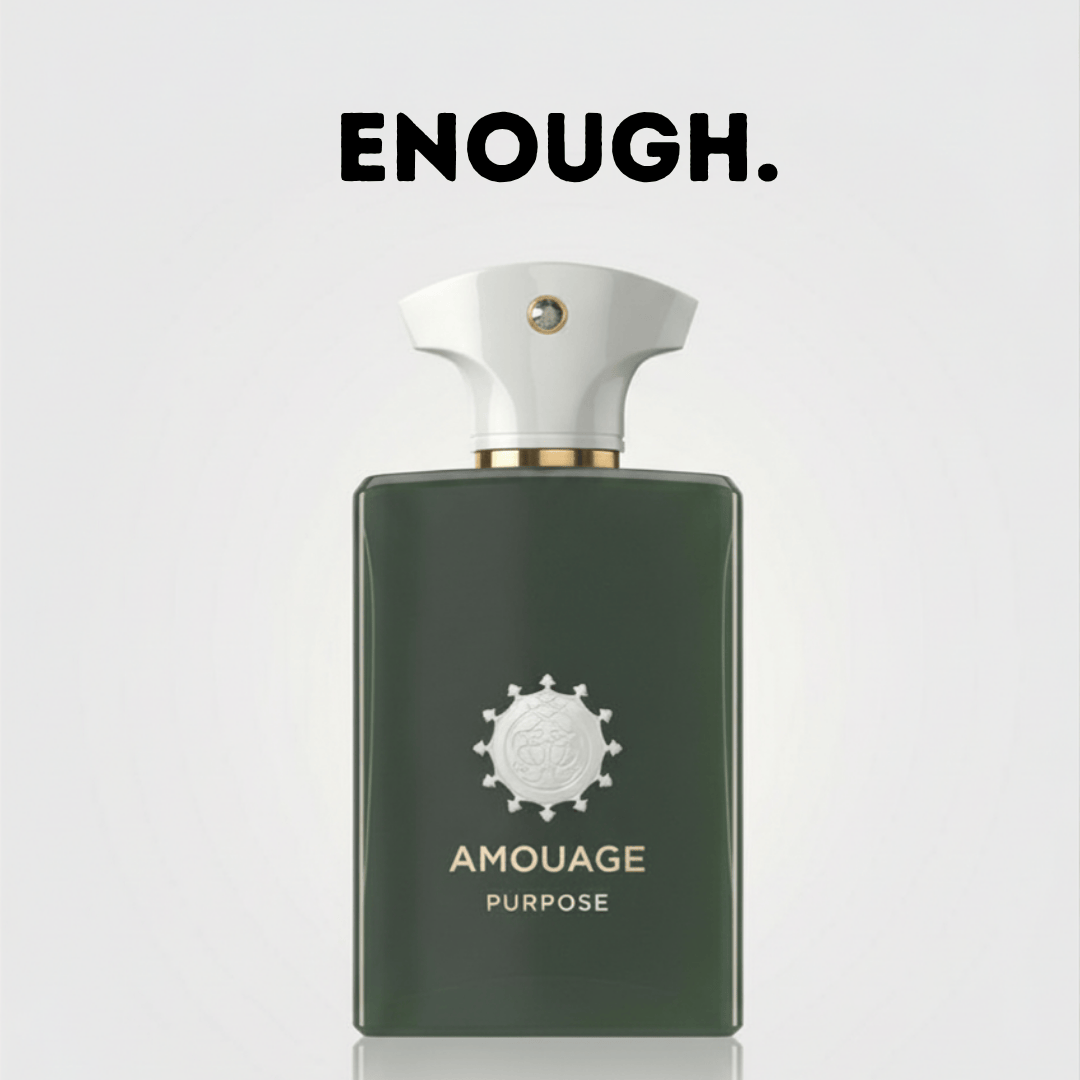
It is within this framework that Amouage Purpose and Amouage Purpose 50 can be considered. They are, in technical terms, variations of the same composition. In practice, they arrive at different conclusions about what that composition is meant to do.
Purpose, in its original form, is built on materials that resist embellishment. The wood is dry, almost papery, nearly austere, with a bitterness that recalls a freshly exposed root rather than anything aged or burnished. Vetiver is present in its darker register—fibrous, slightly coarse and somewhat oily—while Amouage’s characteristic frankincense runs alongside it, not as harsh smoke, but as something more mineral. This incense lends space rather than weight, an impression of air moving through stone.
There is spice at the outset, but it is not the main event; it quickly takes a supportive role. What remains is structure, this fragrance is architecturally very defined. The composition does not unfold in the conventional sense. It settles early and holds, allowing its materials to speak with relative clarity, its notes an enthusiastic conversation between friends, not a monologue. Over time, what becomes noticeable is not development, but this cadence. It advances, withdraws and returns in measured intervals, less concerned with occupying space than with revisiting it.
Purpose 50 retains the architecture of the original, but alters its surface and its intent in favour of a pronounced smoothness with reduced dryness. The edges are softened, the grain compressed into something rounder, more continuous. The vetiver is still discernible, though less sharply defined than in the original. The frankincense loses some of its mineral edge, replaced by a warmth that carries a faintly vanillic inflection. The composition feels fuller, but also more resolved.
With that resolution comes a change in Purpose 50’s behaviour. Whereas the original is more boisterous, more expressive, the extrait remains more on the periphery of consciousness, like a bell heard in the distance. It sits closer to the skin, but persists with unusually robust tenacity. Hours pass with little variation. A full 24 hours later, it continues, somewhat changed from a day earlier but many degrees less than the beginning to end progression in the original. Unlike the original it arrives and recedes; it settles in and stays.
Purpose 50 is masterful, but a different direction to the DNA than I personally prefer. What is lost is not simply contrast, but contingency. The original allows for interruption, for the possibility that something unexpected might follow and make the wearer sit up. The extrait closes that possibility. It completes itself too thoroughly.
I have never found permanance, in fragrance, to be an unqualified virtue, especially at its more extreme limits as is the case in Purpose 50. What remains indefinitely can begin to feel less like presence and more like imposition. A composition that does not yield leaves little room for change, and less still for choice.
There is certainly a technical accomplishment in sustaining a fragrance so completely, which I do not mean to criticize. Within the context of Amouage’s Exceptional Extraits, Purpose 50 is entirely coherent, its density and persistence aligning with what that category now represents. But coherence is not necessarily better.
Amouage is not the only house increasing perfume oil to alcohol ratios in its compositions, that is an industry wide trend. Across the extrait landscape, similar tendencies appear. Compositions are made denser, longer-lasting, more self-contained. In some cases, this deepens their character. In others, it reduces their sense of movement. I submit the assumption of improvement is not always borne out.
None of this diminishes the work of master perfumer Quentin Bisch, who was instrumental in both Purpose and Purpose 50. Equally criticized and adored, his approach here is assured, recognizably his (yes, both Purposes have akigalawood), yet distinct in its execution.
Both Purposes manage to remind one of classic Amouage cannon, yet there is little else quite like them. Each version demonstrates a clear compositional logic, even as they diverge in effect.
I find myself returning to the original Purpose more often. Not because it is less, but because it allows for more. It speaks clearly, recedes, then speaks again. It leaves space for the day to change, and for something else to follow. It’s not that Purpose 50 is not an amazing fragrance—it is—but that it is more introspective than what I want. The 12 hours of performance I get from the original is more than enough for me.
Not everything benefits from extension. Some things derive their meaning from limit, from the fact that they do not remain indefinitely. In such cases, enough is not a deficiency, but a measure.